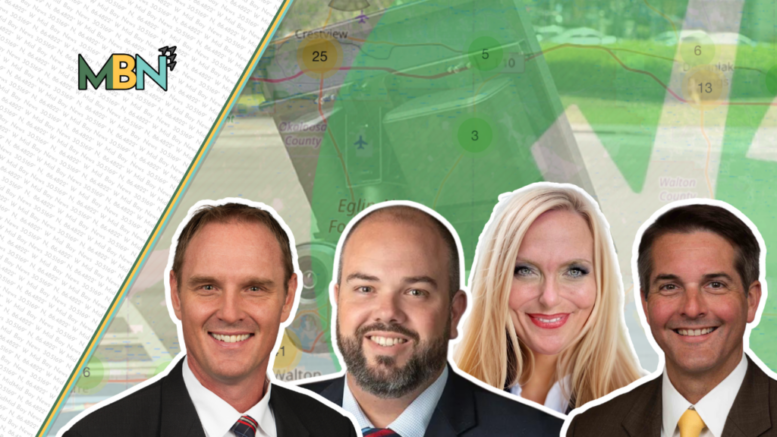
Okaloosa County Commissioners question license plate reader cameras
CRESTVIEW — Okaloosa County commissioners took a deeper look Tuesday at a growing network of automated license plate reader cameras mounted along county roadways, debating privacy, data control and recurring costs.
At the same time, law enforcement defended the technology as an essential investigative tool.
Deputy County Administrator Jason Autrey briefed commissioners on the cameras, commonly called license plate readers (LPRs), and stressed that the county itself does not operate any citation-issuing red-light or school-zone systems.
“We have no mechanism on county-maintained and owned roadways where we issue citations,” Autrey said. “Okaloosa County does not have that.”
Instead, the cameras residents see along roadways belong to the Okaloosa County Sheriff’s Office, which contracts with the private vendor Flock Safety. Autrey said 28 cameras are installed on 26 county roadways, all by permit.
According to deflok.me, around 100 cameras are currently located within the county. According to county officials, the other cameras are located on state roads or in the other nine municipalities.
Crime-fighting claims and investigative examples
Autrey described the network as a “manpower multiplier,” saying deputies can query the database to find vehicles tied to an investigation.
“They’ve used it for stolen vehicles, missing persons, even a juvenile that was claimed missing,” he said, noting one case where deputies believed a teen was headed north but later found the vehicle in Ocala after LPR hits plotted its path.
Flock’s marketing materials, included in county records obtained by Mid Bay News, promote the cameras as crime-reduction tools and describe reductions in calls for service and property crime in communities where the systems have been deployed.
The company bills itself as “your partner in eliminating crime.”
Commissioners raise surveillance and transparency concerns
Commissioners said they have heard from residents who are uneasy about unmarked black poles supporting the cameras.
Board Chairman Trey Goodwin said they feel different from visible security systems.
“You kind of have this distinction between a security camera and a spy cam,” he said. “These feel… a little more like a spy cam.”
Commissioner Sherri Cox voiced concern about both residents and deputies.
“It bothers me a good bit… that our [law enforcement officers] can be tracked by some unknown entity out there that is just a private contractor with no really full accountability,” Cox said.
Goodwin said most residents he has spoken with support law enforcement having investigative tools, but remain concerned about data being housed on a private company’s server.
“Flock does not own and shall not sell customer data. Okay… prove it,” Goodwin said.
“There’s this distinction between a security camera and a spy cam,” Goodwin said. “I think people can embrace security cameras. I don’t think people like spy cams.”
He suggested the cameras could be clearly marked, similar to visible deterrent security systems used by businesses.
Commissioner Paul Mixon acknowledged mixed feelings about the technology while pointing to the broader reality of modern surveillance.
“I think sometimes we forget how advanced technology is,” Mixon said, noting that cell phones and vehicles already generate extensive location data.
He said license plate readers are limited to public roadways funded by taxpayers and do not appear on private roads.
“I’m not the biggest fan, but that doesn’t mean I can oppose it,” Mixon said. “I drive with as a privilege on a public road that I pay public taxes to be a part of.”
Mixon said his initial concern centered on the lack of public notice when the cameras first appeared, calling it a communication failure that has since been addressed.
Subscription traces back to a 2021 agreement
Records show the Sheriff’s Office did not purchase the cameras outright. Instead, it entered into a subscription agreement in 2021, as evidenced by a $196,875 purchase order for 75 cameras obtained by Mid Bay News, with recurring billing tied to that deal.
The paperwork lists the arrangement as an annual service agreement, and later invoices continue under the same umbrella contract, reflecting a model in which the county pays ongoing subscription fees.
At the same time, the vendor retains the equipment and cloud platform.
One summary in the packet shows typical estimated costs of:
- about $2,500 per camera, per year
- totals reaching into six figures annually when scaled
- additional implementation and service charges
National network raises broader questions
Beyond local use, public records disclosures show that Flock data often participates in broader sharing networks.
Agencies can opt to share camera data across jurisdictions — sometimes across state lines — allowing other departments to query cameras they do not operate themselves.
FOIA logs released in late 2025 showed that the Okaloosa County Sheriff’s Office participated in a broader sharing network, granting access to 507 outside agencies for access to their system.
Records also show that between November 1 and December 8, 2025, over 7,000 searches were conducted. Ranging from being on the lookout notices, investigations, missing persons, warrants, agency assists or suspect vehicles.
Civil-liberties advocates, such as the American Civil Liberties Union, warn that such interconnected systems can track vehicles far beyond local borders, even when no crime is alleged.
Furthermore, Flock cameras can be accessed for less-than-ideal reasons. In October 2025, a Niceville Police Officer was arrested after allegedly misusing law enforcement databases in a dispute with another officer’s family.
According to Flock, participating agencies control who they share with and retain ownership of their data. Critics argue that, in practice, oversight is often opaque and policies are inconsistently enforced.
“No push to take this tool away,” but calls for oversight
Commissioner Drew Palmer said storing data locally would be costly, but backed more precise audit mechanisms.
“What would an audit look like?” he asked. “What information would be expected to be gained?”
Autrey said he plans to discuss audit logs, signage and transparency measures with the Sheriff’s Office.
“There’s certainly no push to take this tool away,” Autrey said.
Goodwin said citizens are right to keep asking questions.
“You don’t know what you don’t know,” he said.
Mid Bay News has reached out to the Okaloosa County Sheriff’s Office for further clarification, but has not received a response.

The post Okaloosa County Commissioners question license plate reader cameras appeared first on Mid Bay News.

Be the first to comment on "Okaloosa County Commissioners question license plate reader cameras"