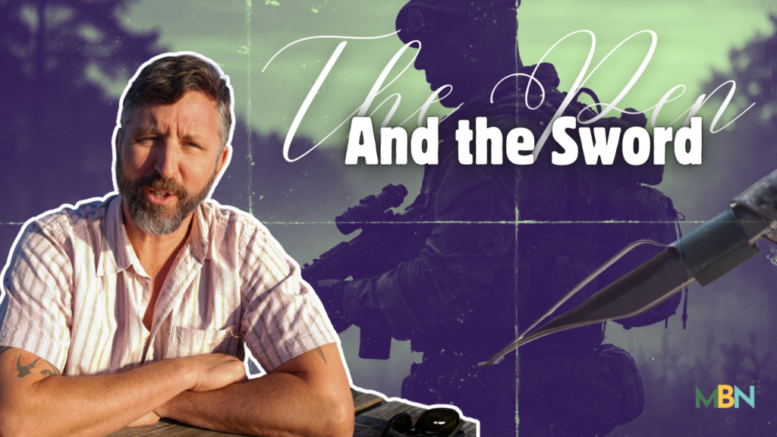

Niceville Resident, Former Special Forces Officer Releases New Children’s Book
-
Christopher Saul
-
January 27, 2026
-
10:41 am -
Niceville
One conversation with Niceville Author Dan Pace – and you are ready to nuke the clutter of busy crap in your life and focus on what’s actually important.
Instead of running with your hair on fire and a Fisher-Price molded plastic case with a roll of Band-Aids from emergency to emergency, you want to focus.
Focus on the problems you can control. Focus on the issues that actually matter. Focus instead of giving in to the industrial attention deficit disorder that has taken over American culture.
So, when Dan, full disclosure, asked me to do some marketing for his three books that will finish their releases in the first half of this year, I was excited.
His new offerings, The Whale and the Kraken (out now) and a memoir of an enlisted man during the invasion and occupation of Afghanistan, It’ll Buff Out (out in February), cover vastly different sides of the same human experience. One is a children’s book that reads like a book that is definitely written for kids, but with the knowledge that parents will read it to them. The other is a reflective look at the war that many in his generation fought. It’s not a ‘strategic overview’ or something more academic (he’s already sort of addressed that here), it’s a story about soldiers.
“I started writing because I had this sense that I needed to understand what I had done in the military,” Pace said in a conversation I had with him in January. “Frankly, it just kind of started with that, and there were problems that weren’t getting addressed. I just started putting pen to paper, and I started with a lot of articles and a textbook to address those. Then, it kind of just grew into storytelling.”
The Whale and the Kraken
The first thing you notice in The Whale and the Kraken, aside from the fountain-pen creations that ink the pages of Dan Pace’s new children’s book, are the asides.
As a parent, like Dan, I read a lot of children’s books. And like Dan, sometimes, I dread the witching hours between six and eight in the evening when it’s my job to read the latest marketing ploy to take my kids to Disney World disguised as a bedtime story.
But Dan’s done something about it. Instead of reading the same thing over and over, he’s written his own children’s book – that doesn’t stay on the surface level. Instead, it dives into deeper themes like animosity between groups, and learning questions our preconceived notions about others.
And he does it all with partial asides that read like tongue-in-cheek one-liners from The Bard himself.
The Whale and the Kraken germinated through the arguments in the backseats of the family minivan across the Mid-Bay Bridge from Niceville to Destin and then back again. The trip requires visitors to the World’s Luckiest Fishing Village to pass by the giant mural, called the Whaling Wall (not to be confused with similarly-named and much older Wailing Wall in Jerusalem), on the side of a local boat dealership.
As they passed by, the kids in the backseat would start up arguments and discussions about whether or not the whale and kraken in the middle of the scene were buddies – or worst enemies. It’s one of those conversations you have when your kids are looking out the window of the car instead of at an iPad. The debate, especially in the close quarters of the family minivan, is intense.
When it came time to write a children’s book – he knew he’d need to settle the debate (or start a whole new chapter in the argument).
Without giving too much away – a whale and a kraken, who come from two totally different families and cultures that fear the other, strike up an unlikely friendship – in a meaningful way that highlights the qualities he wants his own family to extol:
“Sometimes I feel like the books I read at bedtime are actually teaching my kid backwards,” he said of most of the children’s books he reads. I wanted The Whale and the Kraken to be different. I wanted it to convey a message that resonates deeply with me–that we need to ignore what the world tells us about each other and treat people as individuals.”
It’ll Buff Out
After Dan graduated from Texas A&M, he had a lot in common with driftwood. By his own admission, he’d been a less-than-stellar student – and spent most of his time, let’s just say, carousing.
In a search for purpose and direction, Pace enlisted in the army. Far from the wide breadth of humanity, during the conscription years, he met many people for whom the army was either a way up or a way out, or both. Enter the All-volunteer force.
“The all-volunteer force was kind of created in response to Vietnam, and we decided that conscription was too politically caustic to keep doing,” Pace explained to me, “We’re gonna go to an all volunteer force, but I think an unforeseen consequence to that is it meant that it really selected for a much narrower range of folks who are going to join. It tends to become a little bit hereditary, because otherwise, you just don’t know anybody in the military. So, ‘why the hell would I ever join that? It looks like lunacy.’ Whereas, with conscription in theory, you use, you collect a slice of the entire population, so you get rich kids, poor kids, middle-class kids, doctors’ kids. But with this, really, you’re gonna get people who really hunger for adventure, or who don’t have a better option. And so I think you select for a much broke-r and less educated group of folks, frankly, to join the army than you would get under conscription. I’m actually a little more pro-conscription, in the sense that I think if we’re going to start a war, we should probably ensure that everyone has some skin in the game. Otherwise, it makes it a little too easy.”
Pace hopes that this book will get people to rethink the way we do war by focusing on what it does to the young men who fight it – and reveals how those same soldiers deal with it.
—
Attention spans
After a career in the military that took him around the world, to Iraq and to Germany, Pace believes in the power of the book as a medium to solve a lot of the modern world’s ills. For one thing, it’s something physical in the world of passing electronic pulses and devices that seem to distract and separate people better than a well-executed ambush.
You see, Dan thinks that the advances of the 21st century are what they are – and that ‘are’ is not a universal good. Social media splits us up into camps when we are really much more alike and in agreement than we might thing. Having our face buried in a screen burns out adults and stunts kids. It shortens our attention spans. His solution, in part, is the book.
Books, after all, demand more than just the cost of a novel (a paltry $19.99 for The Whale and the Kraken and even less for It Was What It Was, his reflections on serving as a company commander in Iraq. They demand a time investment on top of that. In return, they give us a return on investment – just not always an immediately quantifiable one that we can put on a KPI sheet and proudly present to our bosses while we ask for a COLA. The return is more qualitative and infinitely more important. It’s in the way we can learn better ways to live, in the empathy we can build for others who have experiences we don’t. It comes in not making the same mistakes others have made – and still benefiting from learned experience.
Books and the conversations (or arguments) they create have that value in Pace’s opinion. They “allow people to hammer out ideas and to work through things in a way that a text message or an exchange of digital communication can’t.”
He points to the scrupulously managed calendars of military general officers – managed in five-minute blocks. The inability to spend dedicated time on issues, as we do when we read books, forces us into a feedback loop where we’re forced to move from fire to fire instead of making substantive change in the things we can control. “At what point do you, as somebody with 40 years of service and experience, have the ability to apply the judgment that you could bring to the table if you were just able to chew on ‘what are we doing in Ukraine?’ How should we handle that,” Pace explains. Instead, he argues, our culture programs us to “sound bite it [and regurgitate it] for 500 meetings over six days.”
He says we were better managed during the height of World War II, when General George Catlett Marshall, one of the greatest officers in American history, took a daily ride near Washington, D.C., on horseback.
“You think, well, probably during that horse ride is when he was chewing some of the bigger decisions, like, ‘should we invade Fortress Europe?’ he argues, “I feel like we totally cheat people out of that ability anymore. Who has time to do anything but respond? If you ask me a question, I have no time to think about it. You’ll get my answer. Is it a good one? I don’t know. Maybe the answer that I gave you all you’re gonna get now, I have to move on.”
He hopes that when people invest their time and money with him in his books – whether they are kids’ stories or his memoirs of life at war – they get some of the same things. “You know, with the world that makes people want to kind of read more and investigate more. I want the experiences in Iraq and Afghanistan… I want people to be able to live and understand what it was like to be there. I want them to be able to just see it and breathe it. And it’s the same with kids’ stories.”

The post Niceville Resident, Former Special Forces Officer Releases New Children’s Book appeared first on Mid Bay News.

Be the first to comment on "Niceville Resident, Former Special Forces Officer Releases New Children’s Book"