SS United States Toxic Final Voyage to the Depths
Okaloosa County Commissioners plan to sink the SS United States 22 miles off Destin Beaches in mere weeks. But critics and some experts say that sinking this ship could lead to a potential environmental disaster on the Emerald Coast.
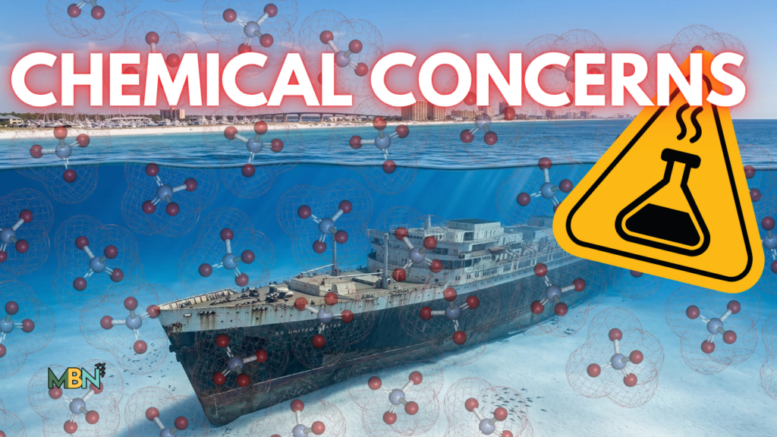
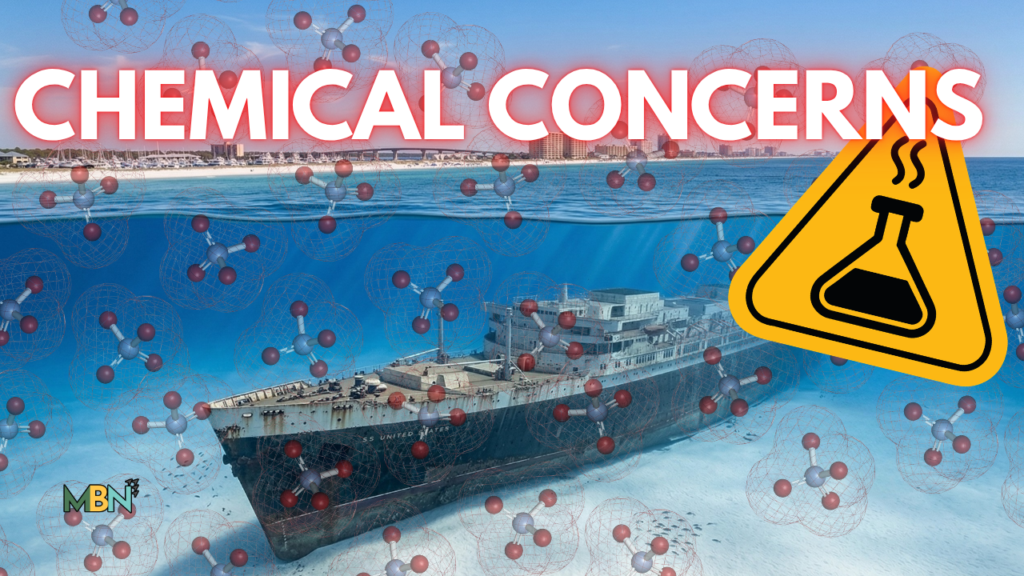
Okaloosa County officials are finalizing plans to make the SS United States the largest vessel ever deployed in the County’s expansive reef program. The ship’s size, history, and prior remediation work make it a rare opportunity that could accelerate deployment while delivering a major boost to marine habitat and diving tourism. Questions remain about the safety of reefing this historical vessel, which is covered in toxic coatings such as zinc chromate to protect the ship’s metal. Experts say the SS United States poses an environmental, historical, and factual problem of significant importance.
It is important to note that experts and county leaders alike are unsure about how much zinc chromate, which contains hexavalent chromium, a known carcinogen, will actually leach into our Gulf waters. This fact alone presents one of the most powerful questions that should be considered by everyone involved in this reefing project.
Expert Perspectives
The SS United States Preservation Foundation submitted a range of documents, testing data, lab results, and expert testimony highlighting concerns about the estimated 60,000 pounds of zinc chromate on the vessel. More importantly, zinc chromate containing hexavalent chromium, a compound recognized by officials as carcinogenic. Dr. Todd Z. Osborne created a Youtube video for the commission to view concerning the carcinogens he worries will sink with the ship. Osborne earned a Ph.D. in Biogeochemistry from the University of Florida and currently teaches at the university in Gainesville.
An earlier version of this story said that the video was placed on an agenda for Okaloosa County Commissioners to view. We could not find the agenda item on their website. We regret the error.
According to Dr. Osborne, the zinc chromate coatings, which used a total of 8,428 gallons of zinc chromate-bonded paint, would be difficult to remove completely before the ship is made into an artificial reef.
He believes that, in total, there were roughly 27,000 kilograms of zinc chromate used on the ship when it was built.
“It is my professional opinion that [the SS United States] has no place in [sic] our ocean floor where it can have detrimental effects on our marine resources. I implore you to take these facts under serious consideration prior to utilizing this vessel as an artificial reef.”
Dr. Alexandra Muñoz, an independent toxicologist with a doctorate in molecular toxicology, has extensive experience in heavy metals and evaluating their impacts on human health.
Muñoz relays concerns over the County’s intentions to sink the SS United States to create the world’s largest artificial reef.
“The Okaloosa County Commissioners need to consider whether they are comfortable with their snorkeling reef leaching carcinogenic hexavalent chromium (Cr-VI) at levels that are potentially well above their current estimates and whether they want to bear the burden for the potential consequences of that leaching,”
Muñoz questions whether the full extent of the impact of hexavalent chromium has been considered.
Again, there is an unknown here that has to be fully considered before the deployment of this vessel. Exactly how much hexavalent chromium will be introduced into our Gulf water? Until that question is fully understood and examined, many believe that Okaloosa County is rolling the dice by potentially contaminating an underwater ecosystem with carcinogenic hexavalent chromium.
Alexandra Muñoz goes on to say, ”Hexavalent chromium will likely leach into the water from this ship. If officials are wrong in assuming it won’t be a problem, then ‘waiting to monitor’ means you only find out after it’s leached.”
The Foundation
SS United States Preservation Foundation Co-Founder Carlos Comacho and Okaloosa County Public Information Officer Nick Tomecek seem to take opposite sides of the proverbial fence regarding what is best for the public, the ecosystem, and the SS United States itself.
Camacho, a vocal opponent of sinking the ship to create a diving reef, says the plan is something of an abomination. He believes the ship is on par with other historic sailing vessels, such as the Queen Mary, and therefore is a piece of history that should be preserved on land. In addition, he worries that the chemicals used on the ship, such as hexavalent chromium (Cr-VI), can harm the ecosystem and the people who enter it, including snorkelers and divers, as well as those who fish the artificial reefs.
“What they decide about this ship will be part of Okaloosa County’s legacy long after every commissioner has left office.”
Tomecek, the spokesperson for the county that purchased the SS United States with the stated goal of sinking it and creating an onshore museum about the vessel’s history, argues that the course of action the County plans to take is the best possible way to safely and economically preserve the ship’s legacy.
RELATED: ANOTHER delay hampers SS United States trip to the bottom of the Gulf.
“It is important to note that all exfoliating paint throughout the ship, whether on the exterior or interior, has been scraped off, vacuumed, and transported to disposal facilities. Aluminum on the ship is not a concern, as aluminum is commonly deployed in artificial reefs. PCBs [other chemicals] have been extensively remediated in coordination with the EPA. They made two site visits and were satisfied with the work. Zinc chromate is not a federally regulated material requiring removal from the vessel. It’s treated similarly to lead and asbestos, and means it can remain on the ship as long as there is no peeling paint containing the substance.”
In a statement to Mid Bay News, Tomecek said Okaloosa County is using the Best Management Practices for preparing the vessel for reefing. His statement was echoed by the EPA when we contacted them.
No concerns for the County and its scientists
The planned reefing has brought renewed attention to the ship’s original construction materials. More specifically, that zinc chromate coating was applied extensively to protect the vessel’s steel and aluminum surfaces. Again, zinc chromate contains hexavalent chromium, a compound now recognized as toxic and carcinogenic by the Environmental Protection Agency (EPA) and the World Health Organization (WHO). As Tomecek said, zinc chromate itself is not regulated by the EPA. But hexavalent chromium, which is what is released when the zinc chromate breaks down, absolutely is. The County could also be liable in a lawsuit if the federal government finds that the ship is deployed, containing hexavalent chromium levels exceeding allowed limits on board.
RELATED: Dive Into History: SS United States Reef Project
Helpfully, Public Information Officer Tomecek put us in touch with a marine and benthic ecologist named Dr. Kirsten Meyer-Kaiser, Ph.D. Dr. Meyer-Kaiser is an expert at the Woods Hole Oceanographic Institution who studies living things at the very bottom of bodies of water. So seafloors are her specialty.
She says there isn’t much to worry about with a chemical like hexavalent chromium because there just isn’t enough to cause issues for the environment and the people who live around it. “All loose paint is being removed [from the SS United States] before sinking, so this will greatly reduce the amount of chromium that sinks with the ship. Cr-VI is highly soluble; however, the chromium will likely be released very slowly and diluted in a very large volume of the ocean. My team at Woods Hole Oceanographic Institution has partnered with Okaloosa County for long-term monitoring of the SS United States. Hexavalent chromium is one of the chemicals we will measure over time. We do not anticipate large concentrations of Cr-VI in our samples. We will communicate our findings to Okaloosa County as we progress through this long-term process. In short, while Cr-VI is present, the concentrations are not likely to be of any concern, and we will be closely monitoring the vessel.”
She added, “Chromium does not bioaccumulate in the food web. Bioaccumulation of toxins in marine life is much more of a concern with PCBs and mercury, all of which have been properly removed from the vessel…” Full remediation of the SS United States before sinking sets it apart from the estimated 3 million shipwrecks worldwide. In addition, the WHOI team will be monitoring many compounds around the ship, including zinc, hexavalent chromium, and others.”
Full remediation, a repeated key takeaway phrase, needs to be examined further. What does the County consider as full remediation? Is that consideration echoed accurately to the experts partnered with Okaloosa County to monitor this site?
More about the SS United States and the artificial reef program
At more than 990 feet long, the SS United States will not only be the largest vessel ever deployed in Okaloosa County, but it is also one of the fastest passenger ships ever built. In fact, the SS United States captured the Blue Riband for the fastest Atlantic crossing by a passenger liner, a record she still holds. Constructed with a unique combination of steel and aluminum to reduce weight and increase speed, the ship will represent a different class of artificial reef. Its size creates more vertical relief, supporting distinct habitat zones from the seafloor to the upper water column. This is significant because the SS United States will become a habitat that no other local artificial reef structure can match.
Food for Thought
Okaloosa County has built one of the most extensive artificial reef programs in the Gulf, with more than 500 reefs in place, including over 20 large vessels. Within months of deployment, bare hulls begin to host algae, barnacles, and coral, drawing in baitfish, snapper, grouper, and larger pelagic species. What starts as steel, concrete, and aluminum quickly evolves into a thriving underwater ecosystem that supports marine life while fueling tourism, fishing, and diving along the Emerald Coast.
If the SS United States ultimately settles on the Gulf floor, it will not mark the end of her story. Over time, its hull would be transformed by coral growth, marine life, and the steady rhythm of the currents. However, that transformation carries responsibility. It falls to the EPA, Okaloosa County, the U.S. Army Corps of Engineers, and other regulatory agencies to ensure the reefing process does not introduce harmful chemicals into our Gulf waters.
The Army Corps of Engineers, the lead agency overseeing this reefing project, was contacted for comment. They reached out to Mid Bay News with their public relations contact information. Should they respond to our requests for comment, we will update the story.
The post SS United States Toxic Final Voyage to the Depths appeared first on Mid Bay News.

Be the first to comment on "SS United States Toxic Final Voyage to the Depths"